The GDPR Deadline Register
The gdprIQ workbook for the clocks the GDPR sets: one-month requests, 72-hour breaches, retention dates and consent refreshes, kept in one register
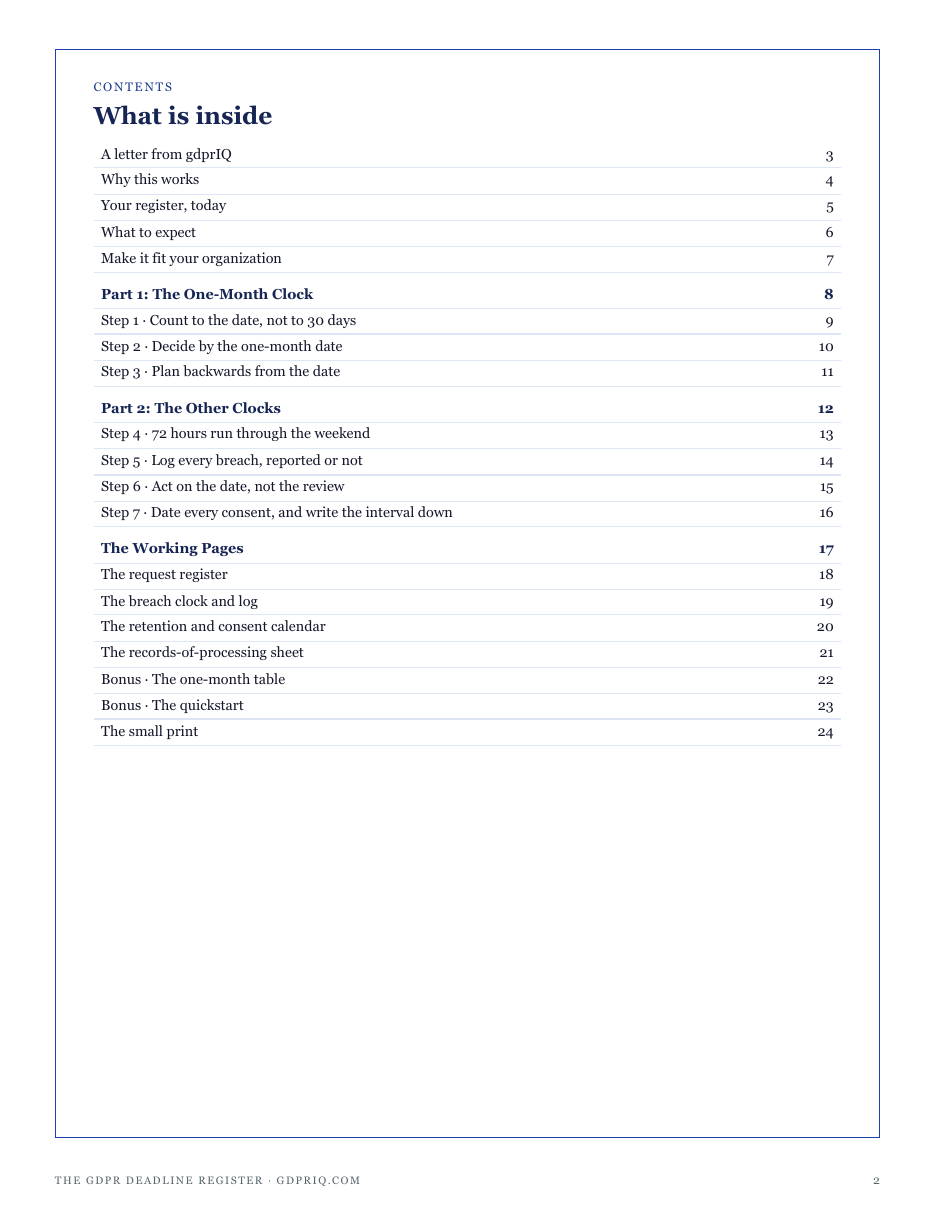
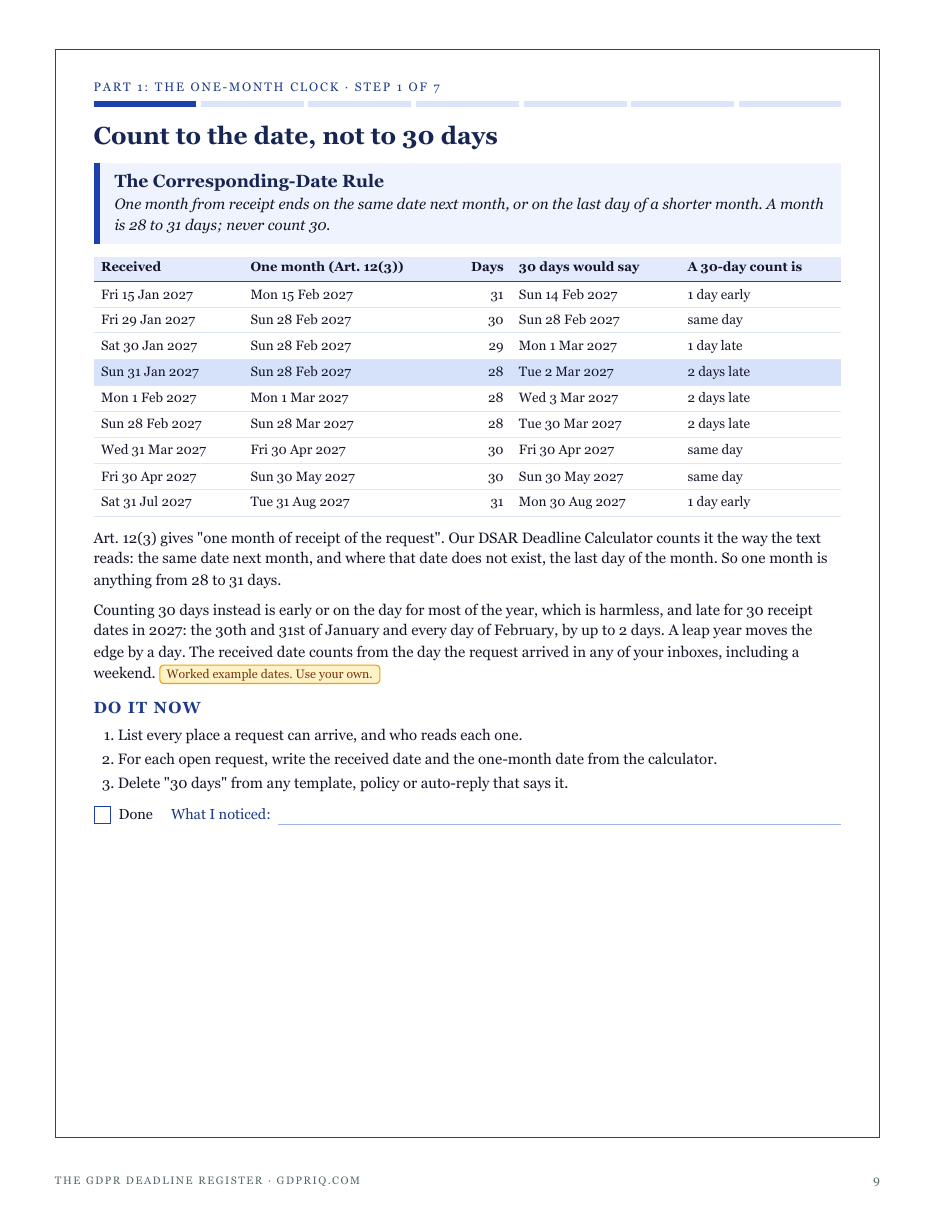
The site's DSAR Deadline Calculator and Breach Notification Deadline Calculator each give one date for one event. The work is a register of many dates, and they are easy to get wrong in ways a single answer does not show. "One month" under Art. 12(3) runs to the corresponding date, so it is 28 to 31 days: a team counting 30 days is late for every request received in February. And 72 hours run straight through a weekend. The GDPR Deadline Register turns the calculators into one register. Part 1 counts each request to the date (received Sunday 31 January 2027, due Sunday 28 February: 28 days, and a 30-day count is 2 days late), makes the one-month date the decision date for responding, extending with reasons or giving reasons for not acting, plans the extended outer date to the earlier of its two readings (28 April, not 30 April), and sets six milestones back from the date, moved earlier off weekends. Part 2 puts a Friday 17:00 breach on paper for Monday 17:00 (48 of the 72 hours are the weekend), logs every breach under Art. 33(5) whether reported or not, acts on retention dates with a look-ahead review (a quarterly review can otherwise act 91 days late), and dates every consent with its evidence. An organizational workbook, not legal advice. Articles and time limits are cited from the text of Regulation (EU) 2016/679; worked dates are examples and house milestones are named as rules of thumb. It never says whether a breach must be notified, whether a request can be extended or refused, how long data may be kept, or what a regulator might do: real incidents and interpretations go to a qualified data protection lawyer or your supervisory authority. Includes a request register, a breach clock and log, a retention and consent calendar, a records-of-processing sheet, one-month tables for 2027 and 2028, and a personalized sheet worked on your own dates.
Look inside
Two full pages from the workbook, exactly as printed. Click either to read it at full size before you decide.
What is in it
- One month counted to the date, not 30 days, with the calculator's own arithmetic
- The one-month date as the decision date: respond, extend with reasons, or give reasons
- The extended outer date, planned to the earlier of its two readings
- Six house milestones back from the date, moved earlier off weekends
- The 72-hour breach clock through a weekend, with checkpoints
- A log for every breach, reported or not, with who decided and who advised
- Retention dates acted on time with a look-ahead review
- Consent dated, evidenced and refreshed on a written interval
- A request register, a breach clock and log, a retention and consent calendar and a records-of-processing sheet
- One-month tables for 2027 and 2028, a quickstart, and a personalized sheet worked on your own dates
- ✓ 24 printable pages
- ✓ 10 sections, worksheets and templates
- ✓ A second PDF worked out from the numbers you enter
- ✓ No account needed, just an email address
- ✓ Instant download; link valid 7 days
Price includes any taxes. Sold by GrabURL, who handle checkout and support. The charge appears on your statement as GrabURL.
The workbook turns the free DSAR Deadline Calculator and the free Breach Notification Deadline Calculator into one register of dates. It is an organizational workbook, not legal advice: for a real incident, or any question about what the law requires of you, talk to a qualified data protection lawyer or your supervisory authority.